
Promotion vs. Merit Recognition
When promotion is your only comp lever, the system rewards your best negotiators, not your best performers. Here's what to do instead.


An exec from a scaling Series B company I work with recently walked me through their compensation philosophy, and it was already more thoughtful & refined than most.
They had clear career ladders for every function. Defined levels tied to specific expectations. Plus, transparent pay: everyone at a given level earns the same cash and the same equity.
They’d even built a small workaround (an “expert band” as it was coined) to give themselves flexibility without blowing up the structure.
It wasn’t perfect, but it was intentional. And that’s rarer than you’d think for a Series B org.
Then they said something that piqued my interest:
“The only way anyone can earn more money here is to get promoted. And the people who get promoted fastest aren’t always the people doing the best work, they’re the people who are loudest about wanting a promotion.”
They paused.
“Honestly, it’s the best negotiators who get rewarded. Not always the best performers.”
I hear some version of this a lot. Usually from founders prepping for a raise, who’ve invested real effort in building comp infrastructure, and who are starting to realize this problem is a symptom of the system.
The structure is working exactly as intended.
And frankly, that’s the issue.
How you usually get here
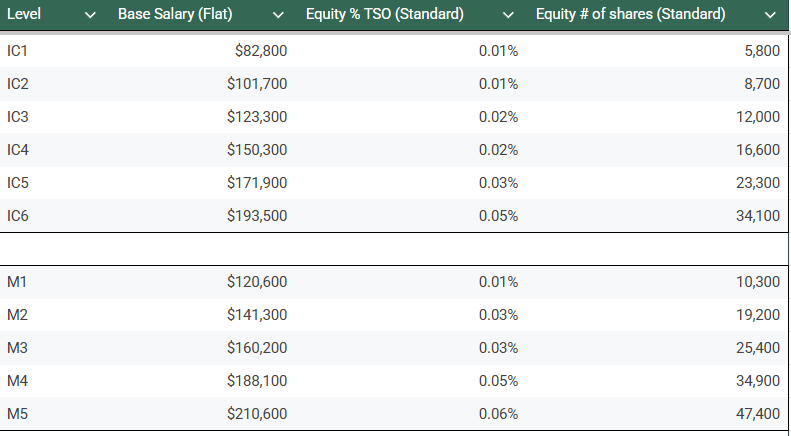
Most early-stage startups land on flat band comp for sensible reasons:
It’s simple
It’s defensible
It removes uncomfortable subjectivity
Everyone at IC5 earns $X.
Everyone at IC6 earns $Y.
Folks knows where they stand, which eliminates (or should anyway) any resentment about who negotiated better.
There’s real value in that — in trust. When employees believe the comp system is fair, they focus on the work instead of the politics.
But flat bands carry a hidden assumption:
The only meaningful “difference” between people is whether they’ve crossed the threshold to the next level.
That someone performing at the top of their grade and someone just clearing the bar are, from a comp standpoint, equivalent.
And that the only way to recognize excellence is by promoting them to a new title.
I’m not sure most founders realize they’ve made that assumption.
They built the system for fairness yet overtime the system communicates something else.
On the flip side, data shows that most workers (92%) believe that companies use inflated job titles to present the illusion of career growth, all while withholding raises and real advancement.
Separating promotion from merit recognition
Promotion and merit recognition are not the same thing.
Promotion = a new job.
Expanded scope
Greater accountability
Different expectations
It should come with higher pay.
Merit recognition = exceptional performance in the current job.
These often happen together. But they don’t have to.
When you conflate them, recognition requires role change… even when the person doesn’t want or need that change. Some of your best ICs perform well precisely because they aren’t managing people.
If your only lever is promotion, you either:
Push them into management
Or lose them
Neither is ideal.
What happens when promotion is the only lever
1. Misaligned incentives
Research from Pearl Meyer found that 54% of organizations now use titles as a primary retention tool… up 35% since 2018.
So when employees realize the only path to more comp is a new title, they optimize for title acquisition.
I don’t think this is a malicious thing. If anything, it’s rational.
How do I make more money?
Well, usually the loudest get attention (demanding a milestone track that guarantees a promotion, threatening to quit, etc.), while the high performers keep their heads down.
When title becomes the currency, then that’s what people will chase. Can you blame them?
2. More promos, more burn
For round numbers sake, let’s say your fully loaded cost per employee is ~$180,000 and you give five people performance-driven promotions over two years (adding $15,000–$25,000 per person) that’s:
$75,000–$125,000 in permanent annual burn.
Not one-time bonus burn.
Recurring burn.
And often, the scope of the job hasn’t changed. It’s just the only card you have left to play.
So yes, that adds up quickly. In an effort to reward performance, you’ve unintentionally raised your fixed costs without increasing output. That’s some expensive recognition.
3. Org design
At an early stage company specifically, senior titles are more structural than anything. Everyone’s already "wearing a lot of hats” (we need a new phrase for that).
A promotion redefines what that role is supposed to do.
Here’s an example: if one of your first hires is named VP of Engineering, but they’re a glorified SWE, this is a vanity title. If that person then eventually does need to take on a people management role as VP, then you’ve already shot yourself in the foot, because they have no where to go, no band to fit into, no title to offer.
If you promote to recognize performance rather than to meet a real organizational need, the result is misalignment
Senior titles without senior scope
Future hiring constraints
Role compression
This tension surfaces at the worst time, usually during hiring, when you’re trying to bring in someone above a person who already has a title they haven’t grown into.
4. A matter of retention
Gallup data shows 33% of employees who changed jobs cited limited growth opportunities as the primary reason.
If the only way to earn more is:
Getting louder about wanting a promotion
Moving into management
Changing identity entirely
Some of your best ICs will leave. they won’t tell you why directly.
Three levers most early-stage companies underuse
1. Salary ranges (instead of flat bands)
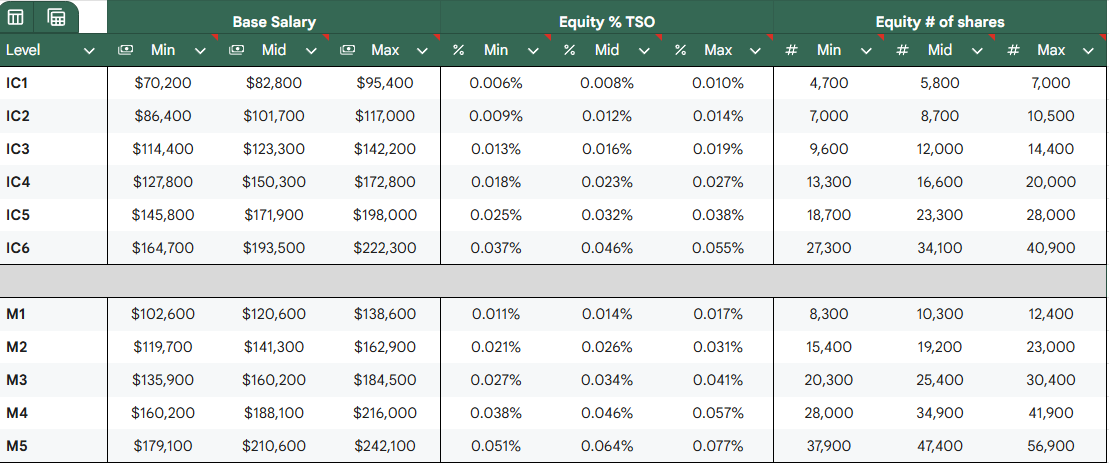
A range sets:
A midpoint (meeting expectations)
Room for consistent over/under performance
A defined ceiling
This allows for differentiation within a level without a title change.
It does require front-end work & infrastructure (documented rationale, regular re-calibration, frequent/clear communication). Without that, ranges are just another negotiating point.
Big caveat here — salary ranges only work if your managers can articulate what “exceeds expectations” actually looks like. If they can’t, you’re just replacing one problem with another.
2. Performance-based equity refreshes
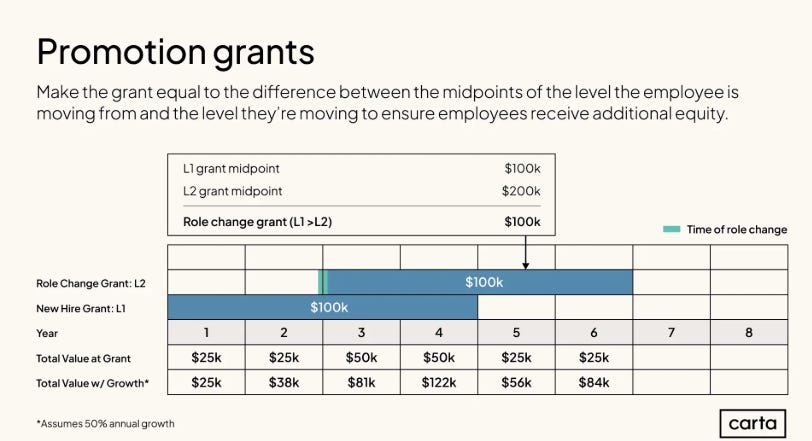
Carta data shows 82% of companies report refresh grants significantly impact top performer retention, while Sequoia’s 2025 equity refresh research found 88% of companies tie refreshes to performance criteria.
Refreshes work because the cost is aligned to long-term outcome. If the company wins, the employee wins more. If it doesn’t, you haven’t permanently inflated payroll.
When you’ve got 12–18 months of runway, this is the move. Equity incentives isthe only lever that doesn’t increase current opex.
3. Spot bonuses (used intentionally)
SHRM estimates a spot bonus program costs ~1% of payroll. Meanwhile backfilling a role that turned over 50%–200% of that person’s salary.
A $10,000 outcome-based bonus is cheap compared to replacing someone who felt invisible.
The key is being specific and transparent.
Like: “You delivered X under Y constraint, which drove Z impact, therefore you’ve earned this”
Not: “You’ve been great.”
Performance → Recognition → Reward → Reinforcement.
A few things to takeaway
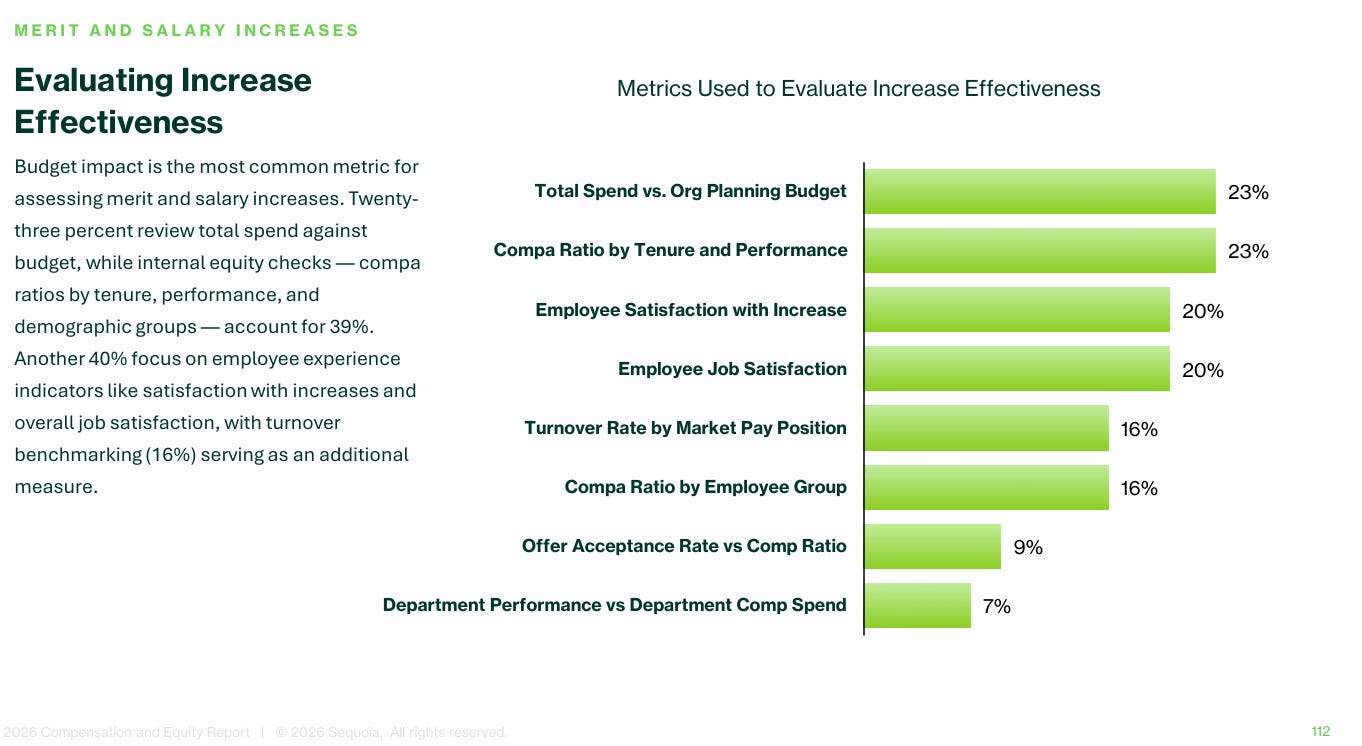
None of this works without defining what good looks like.
If you can’t articulate what exceeds expectations, what meets expectations, & what readiness for promotion actually looks like you’ll recreate favoritism, just through managers instead of employees.
Leveling should focus on outputs and impact. And promotions should be for those ready to take them on (investing on internal development to be ready for that is another conversation).
Promoting someone too early (because you’ve no other option) creates a harder retention problem:
A publicly elevated employee now struggling in scope they weren’t ready for. I’d argue that costs more than the raise would have.
Also, salary ranges require transparency. If managed inconsistently, they become whole new bucket of problems. Clear communications & guardrails prevents that.
Ultimately, promotion and merit recognition are different conversations.
When you treat them as the same, you get title inflation, permanent payroll burn, incentives that reward attention over performance.
A layered comp system works better:
Salary ranges to differentiate within level
Equity refreshes to align with long-term outcomes
Spot bonuses for defined results
The founders who get this right have internal clarity on one distinction:
“This person is doing an excellent job.”
Or
“This person is ready for a new job.”
A Simple Framework
Promotion = new scope, new expectations, new comp
Merit recognition = excellence in current role, permanent salary increase
Levers = salary ranges, equity refreshes, spot bonuses
People Leaders - If you’re rethinking performance recognition for this coming year, check out the data from Sequoia’s 2026 Compensation & Equity Trends report. Shoot me a message if you want to walk through it.
If you found this helpful, check out my other articles on how to:
Subscribe to get the next one.
Or share with someone building their people strategy.
Talk soon,
Cris Cafiero
Business Consultant @ Sequoia
As someone who has worked in HR, the distinction you draw between promotion and merit recognition is spot on, and most teams massively underestimate how much damage they do when they try to solve a recognition problem with an org design decision instead.
This was really interesting and insightful. The distinction between "this person is doing an excellent job" and "this person is ready for a new job" is deceptively simple but most orgs never make it explicit. When promotion is the only lever, you're solving a recognition problem with an org design decision. Those costs compound quietly until you're trying to hire above someone with a title they haven't grown into.
The loudest person getting the promotion while the high performer keeps their head down is a feature of the system, not a bug. Which means fixing it requires changing the system, not managing the people around it.