
Startup Equity: The Most Misunderstood Part of Compensation
From dilution math to exit probabilities: what early stage startup people leaders need to know about employee equity.


Ask ten startup employees what their equity is worth and you’ll get ten different answers. Some will already have their yellow Lambo mocked up and ready for order. Others will shrug, unconvinced that those options will be anything other than worthless. Both instincts hold a shred of truth.
For people leaders of early stage startups, this is the paradox of equity: it’s potentially the most powerful tool you have to attract and retain talent — it’s also the easiest to mishandle. Done right, it builds loyalty and alignment. Done poorly, it breeds confusion, disappointment, and attrition.
Equity can be tangible and valuable and life-changing. Or it can be a mirage. Sometimes it’s water, sometimes it’s sand.
This guide walks through how equity works, where the market is today, and what every people leader should keep in mind as they design and communicate their equity programs.
How Equity Actually Works
Startups hand out equity in a few flavors. Each comes with different strings attached:
Stock Options
ISOs (Incentive Stock Options): Employee-only, with tax advantages if holding requirements are met. They can trigger Alternative Minimum Tax liability (the amount of tax a high-income earner owes under the AMT, in addition to their regular tax bill).
NSOs (Non-Qualified Stock Options): Available to employees, contractors, and advisors. More flexible, but taxed as ordinary income on exercise.
RSUs (Restricted Stock Units): Common in later-stage and public companies. Employees receive shares at vesting, taxed as income, with no exercise cost.
ESPPs (Employee Stock Purchase Plans): Limited to public companies, allowing employees to buy stock at a discount (can be 5-15%).
Here’s a side-by-side breakdown:
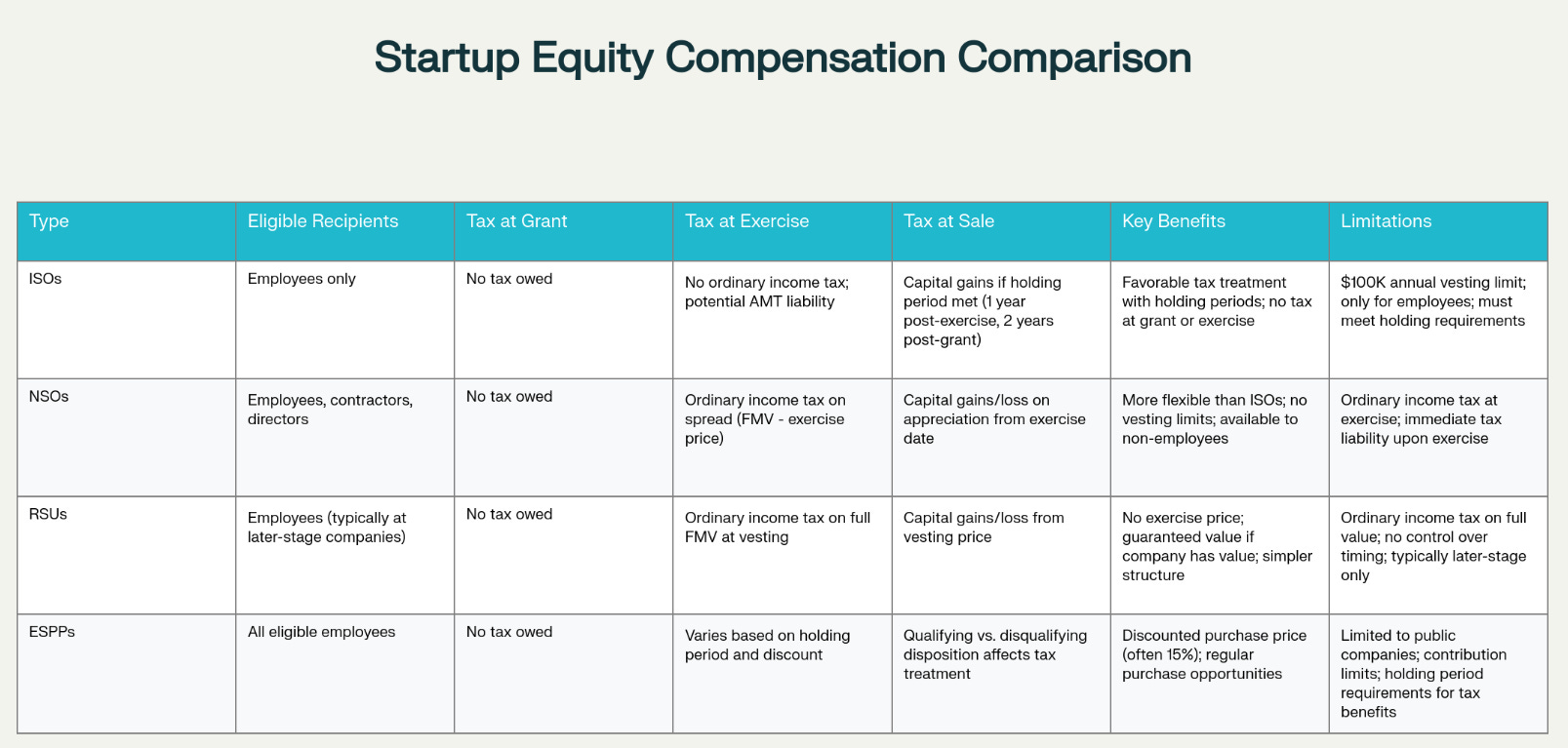
Had enough acronyms yet? Remember: your employees don’t care about the cause — they care about the effect. Explaining these structures in plain language is half the battle.
What the Market Says
Data shows that equity distribution follows a steep curve. Carta data shows the first engineering hire typically gets ~1.5% of equity, while by hire eight, the median drops to just ~0.22% .
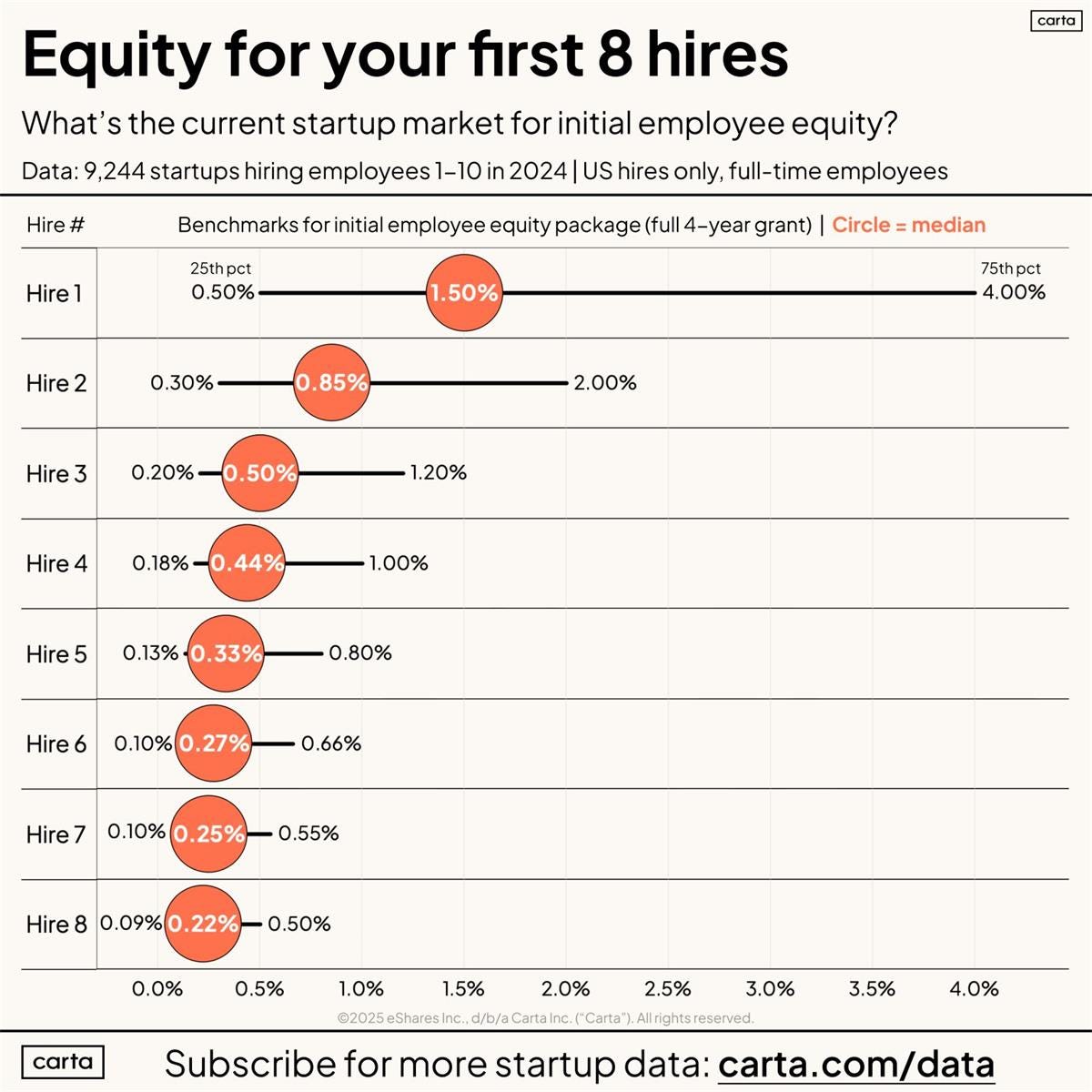
Option pools typically hover around 10–20% of a company’s total cap table. Early-stage companies tend toward the low end (~12% on average), with refreshes as valuations climb. And remember: every funding round means investors are carving off 15–30% for themselves, which directly squeezes how much is left for employees. Hence, dilution.
As an example, by the time you join that hot Series C company, the pool isn’t nearly as generous as what you would have received as a seed stage employee.
Vesting and the Cliff
The market standard remains a four-year vesting schedule with a one-year cliff. That means employees earn nothing until the one-year mark, then vest monthly for the next three years.
Some companies offer “double-trigger” acceleration (acquisition plus termination without cause). It’s increasingly seen as employee-friendly protection, though not universal.
So consider the employee’s perspective. If I’m coming up on my vest and I’m not happy — what do you think I’ll do?
Hit my vest, take the equity, and run.
So remember, attrition risk grows when employees approach full vesting.
A best practice: plan refresh grants before employees hit 75% of their initial grant.
Strike Price and 409A
Every option grant requires a 409A valuation — an independent estimate of your company’s fair market value, updated annually or after fundraising.
Pre-seed valuations often fall under $1 per share
Series A may cross the $1 threshold
Series C can exceed $2.50 per share
For employees, this means later grants are more expensive to exercise — and this is where most employees trip up.
It’s super important that people leaders help employees understand the tradeoff: higher valuations look good, but increase exercise costs.
How Equity Pays Out (or Doesn’t)
There are three possible endings to your equity story:
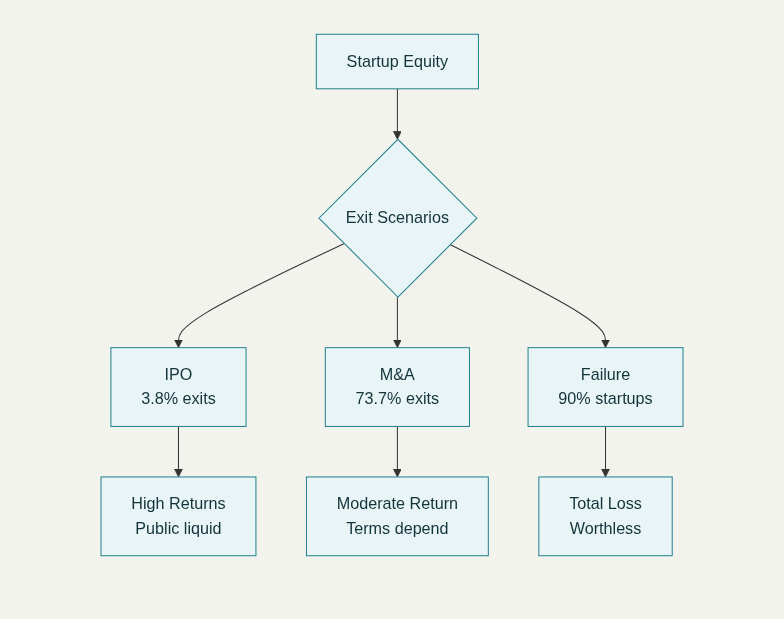
IPO – the Hollywood ending. Rare. In 2024, fewer than 10 VC-backed tech companies went public. Just 3.8% of venture-backed exits are IPOs. When it happens, liquidity is life-changing, but you’ll sit through lockups and volatility.
Acquisition – the most common exit (~74% of VC-backed outcomes). Payouts vary wildly. If preferred shareholders get their liquidation preferences satisfied first, common stockholders (aka employees) may walk away with far less than the headline number suggests.
Failure – the default. Roughly nine out of ten startups don’t make it. If you’ve exercised, you could be out cash plus taxes with nothing to show for it.
People leaders can’t always control exit outcomes, but they do control how honestly those probabilities are communicated.
Equity Glossary: Terms You Should Understand
Strike Price – The cost to buy your options. Lower is better.
409A Valuation – The IRS-approved valuation that sets your strike price. Updated yearly or after fundraising.
ISOs (Incentive Stock Options) – Employee-only, favorable tax treatment, AMT risk.
NSOs (Non-qualified Stock Options) – Broader eligibility, less favorable taxes.
RSUs (Restricted Stock Units) – Shares granted on a vesting schedule, taxed as income.
ESPP (Employee Stock Purchase Plan) – Buy stock at a discount via payroll. Public companies only.
Option Pool – The slice of the cap table set aside for employees (usually 10–20%).
Vesting Schedule – Timeline to earn equity (standard = 4 years, 1-year cliff).
Cliff – Minimum time before vesting begins. Usually one year.
Acceleration – Vesting that speeds up in M&A or termination events.
Liquidation Preference – Determines who gets paid first. Usually investors get paid before employees. Can erase common stock value.
Paper Gains – On-paper value of your equity. Not real until liquid.
Exit – The outcome that determines your equity’s worth: IPO, acquisition, or failure.
Concentration Risk – Having too much net worth tied up in your employer’s stock.
What People Leaders Should Do
Educate early and often. Don’t assume employees understand equity. Build simple explanations into onboarding and offer reviews.
Refresh strategically. Issue new grants before employees reach 75% vesting to avoid disengagement.
Set expectations on exits. Make it clear equity is upside, not a guarantee.
Balance equity with base pay. Equity isn’t a substitute for competitive salaries — it’s a complement.
Takeaway
Equity is the most misunderstood part of startup compensation. For people execs, the challenge is less about how to structure grants and more about clear storytelling.
Equity can be the glue that holds your team together, or the reason they start answering LinkedIn recruiter spam... So don’t ignore it.
Handled with care, it creates alignment, retention, and wealth.
Mishandled, it’s just sand.
People Leaders — if you’re looking for best practices and data on your equity strategy, shoot me a note. Happy to help.
If you found this useful, check out my other articles.
In this newsletter, I share how real startup teams:
Just what’s working — and what’s not.
Subscribe to get the next one.
Or share with someone building their people strategy.
Talk soon,
Cris Cafiero
Business Consultant @ Sequoia
This is so needed. Equity’s often dangled like a golden carrot, but most employees can’t tell if it’s gold or just very shiny sand.
Your breakdown’s honest and jargon-free - especially love the reminder that people don’t care about the mechanism, just the impact. More companies need to say “this is how it works in reality” instead of dressing it up as a lottery ticket.